
A section of industry may need to begin compliance immediately, even as most states are yet to notify their rules.
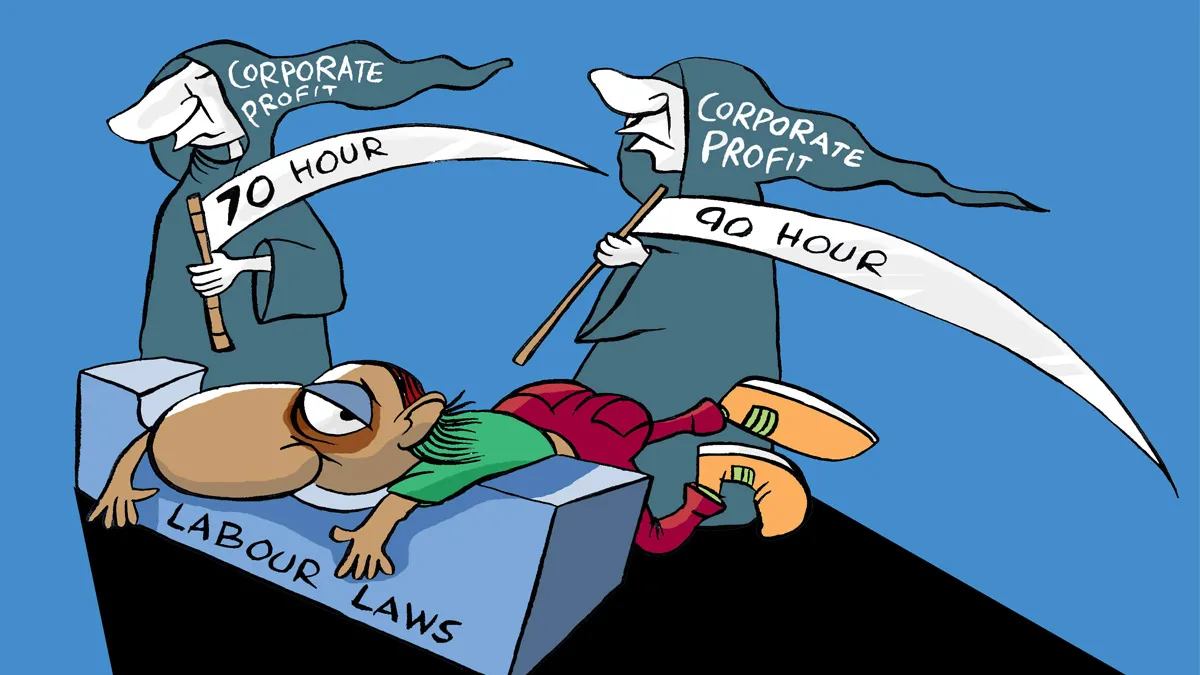
The Indian government has notified final rules under four labour codes, potentially enabling a four-day workweek in certain sectors by capping weekly working hours at 48 while allowing daily flexibility. This move also introduces significant changes to wage fixation, compliance obligations, and social security norms.

Occasionally, the silence of the night shift would be shattered by an ear-splitting alarm: 'ALERT, ALERT... This is a security warning.' We were drilled to move away from the windows and avoid the lifts, recalls Krishna Kumar NP, a veteran Dubai-based journalist.
In a historic decision, the government on Friday announced the implementation of the four Labour Codes, which rationalised 29 existing labour laws, with immediate effect. The four labour codes are -- the Code on Wages, 2019, the Industrial Relations Code, 2020, the Code on Social Security, 2020 and the Occupational Safety, Health and Working Conditions Code, 2020.

The Haryana Human Rights Commission has taken suo motu cognisance of increasing incidents of suicides, unnatural deaths, violence, mental health issues, overcrowding and inadequate psychological support systems in state prisons.

Companies would have to recognise the increase in gratuity liability arising from new labour codes in their interim financial statements and results for the period ending December 31, the Institute of Chartered Accountants of India (ICAI) has said in its FAQs on the new labour codes.

While the move may give a competitive edge over rivals like Bangladesh in the global market, several industry bodies raised concerns that many state governments may not implement it on the ground.

The new labour Codes, notified by the central government in November 2025, have pushed up employee costs for private-sector banks and insurance companies, with these firms reporting higher operating expenses in the October-December quarter (Q3FY26) due to the statutory impact of the new labour Codes.

From appointment letters becoming mandatory to gig workers receiving social security to enhanced rights for women and contract labour, the changes reflect India's attempt to balance ease of doing business with stronger worker welfare.

'It will increase the contribution to gratuity, which is something the employer has to give.'

The situation in Kokrajhar escalated late on January 19 after a Scorpio vehicle carrying three Bodo individuals hit two Adivasi persons at Mansingh Road under the Karigaon police outpost.

The US has expanded its review of social media and online presence to cover all H-1B speciality occupation workers and their H-4 dependents, the US embassy in India said on December 10.

'This agreement will help the Indian workforce to move to non-traditional sectors of employment like teaching, nursing, and manufacturing.'

However, under several external factors -- such as technological disruption or advancement, regulatory or policy changes, or economic shocks -- the gig workforce may grow only to 32.5 million by 2047, a report points out.

Labour Minister Santosh Gangwar said, the purpose of labour reforms is to provide a transparent system to suit the changed business environment.
The four labour codes on wages, social security, industrial relations and occupation safety, health and working conditions are likely to be implemented by the next fiscal year as at least 13 states have pre-published draft rules on these laws, a senior official said. The Centre has already finalised the rules under these codes and now states are required to frame regulations on their part as labour is a concurrent subject. A senior official said that the four labour codes are likely to be implemented by the next fiscal year.
Day 6 of Parliament's monsoon session 2020. Watch all the action in both houses LIVE here.

'The moment they fall foul of the party in power, they become unsafe. Then nobody can guarantee their safety.'
Union Labour Minister Bhupender Yadav has exuded confidence that four labour codes, which would bring another wave of reforms, will soon be implemented as around 90 per cent of states have already come out with draft rules. In 2019 and 2020, 29 central labour laws were amalgamated, rationalised and simplified into four labour codes, viz, the Code on Wages, 2019; the Industrial Relations Code, 2020; the Code on Social Security, 2020; and the Occupational Safety, Health & Working Conditions Code, 2020, noted the Survey. During an interaction, Yadav told reporters that around 90 per cent of the states have already published draft rules on four labour codes and he expects the four legislations would become operational soon.

This will help employers keep a track of the diseases workers could suffer from while doing their jobs.
Ushering in a big wave of reforms by implementing the four labour codes, setting up the national social security fund to cover over 38 crore informal sector workers and improving the ease of doing business will top the agenda of the labour ministry in the New Year. In a major move, the ministry launched the e-Shram portal on August 26, 2021 for creating a national database of over 38 crore informal sector workers. It will help the government to ensure last-mile delivery of benefits of various social security schemes to the informal-sector workers.

The recent protests by employees of Urban Company and the case of a a Zomato delivery executive who died in a road accident point to the severely straitened condition of gig workers during the ongoing Covid-19 pandemic. Budget 2021 had promised several measures to help the cause of gig economy workers, but most of them are yet to see the light of day. Even after a year, the country's gig workers continue to be without any social security cover or a minimum wage guarantee. "In Budget 2021, finance minister Nirmala Sitharaman had announced that the government is looking toward including migrant and gig workers for social security benefits," says Srinivas Kotni, managing partner, Lexport, a consulting firm. Parliament had passed the Code on Wages in 2019 and Code on Industrial Relations, Social Security and Occupational Safety, Health and Working Conditions in 2020.

The Union government is projected to share about 32 per cent of central taxes with states during the financial year 2024-25 against the 15th Finance Commission's recommendation of 41 per cent. The Revised Estimates (RE) for FY24, too, show a similar share of states in the central taxes at 32 per cent. In absolute terms, however, there has been an increase in the amount devolved to states compared to the Budget Estimates (BE) for FY24 at Rs 11 trillion.

After assuming power in 2014 with a full majority of its own, the BJP-led NDA government started an ambitious process of reforming labour laws in the form of codes aimed at making the framework less cumbersome with a variety of alterations. It had planned four codes each for industrial relations, wages, social security and welfare, and occupational safety, health and working conditions. To this end, 35 central labour laws were to be converted into four codes that would have had the virtue of streamlining labour relations. But none of the proposed code Bills could be converted into a law principally because neither trade unions nor industry representatives came on board. They hold the key to India's low-growth-high unemployment paradigm but the government may struggle to push them through this time as well. Somesh Jha explains why
All four labour codes are likely to be implemented in one go from April 1, the beginning of the next fiscal year, labour secretary Apurva Chandra said on Wednesday. The parliament in its just concluded session passed three labour code bills: the Industrial Relations (IR) Code, the Social Security Code, and the Occupational Safety, Health and Working Conditions Code (OSH). The Wage Code Bill, 2019 was passed by the parliament last year.
The Union government will take a bit longer to introduce the much-awaited labour codes even as the majority of states and Union Territories (UTs) have framed rules on them. There were speculations that these would be introduced from July 1. While 30 states and UTs have framed rules on the code on wages, 25 of them have done so on industrial relations. Of the two remaining codes, 24 states and UTs have framed rules on social security and 23 on occupational safety, health, and working conditions (OSH), sources said.

As per the recommendations of the 2nd National Commission on Labour, the ministry is codifying existing 44 central labour laws into four codes by simplifying, amalgamating and rationalising the relevant provisions of the legislations.

Labour ministry guidelines say workers returning to cities must get housing, health insurance, facemasks. The Centre has also asked states to issue guidelines to employers to take care of the needs of migrant workers.

Their implementation is expected to create investment owing to improving ease of doing business as well as initiating pro-worker measures.

A four-page directive was issued by the medical wing of the Union home ministry on Tuesday stating that the next three weeks are crucial in checking the spread of the virus and lack of caution can affect the forces, around 10 lakh personnel-strong, deployed for ensuring the country's internal security and border protection.

The Muslims side said that they have received the letter and it will be deliberated upon in a meeting.

The implementation of four labour codes in one go from April 1 next year will usher in a new wave of reforms in industrial relations and also help in attracting more investments but employment generation will remain a key challenge in 2021. This year has also been a challenging year for the work force as well as for employers due to the outbreak of the COVID-19 pandemic. The government imposed a nationwide lockdown from March 25, which had an adverse impact on economic activities and resulted in exodus of migrant workers from large cities to their homes in the hinterland. Many migrant labourers lost their jobs and it took months for them to return back to their work places from their native places.

In days of smart, networked technology and no shame over collateral damage, what will blow up next -- cars, mobile phones, TV sets, refrigerators? And where?, asks Shyam G Menon.
The four labour codes will not come into effect from April 1 as states are yet to finalise the relevant rules, which means that there will be no change in take home pay of employees and provident fund liability of companies for now. Once the wages code comes into force, there will be significant changes in the way basic pay and provident fund of employees are calculated. The labour ministry had envisaged implementing the four codes on industrial relations, wages, social security and occupational health safety & working conditions from April 1, 2021. The ministry had even finalised the rules under the four codes.
Unlike the other Bharatiya Janata Party-led governments, Assam has not proposed doing away with most labour laws for a certain number of years. Instead it has proposed introducing fixed-term employment to help both workers and industries, and seeks to take more firms out of the ambit of laws governing factories and contract workers.
The four labour codes are unlikely to be implemented this fiscal in view of slow progress on the drafting of rules by the states and also for political reasons like elections in Uttar Pradesh, a source said. The implementation of these laws assumes significance because once these are implemented there would be reduction in take-home pay of employees and firms have to bear higher provident fund liability. "The ministry of labour is ready with the rules under the four labour codes. But the states have been slow in drafting and finalising those under new codes.

However, the government has enacted an important change to the fixed-term employment framework that may help companies in handing out contractual jobs to its existing permanent workforce.

Labour law changes for three years may not be enough as it takes a couple of years for factories to build and operations at a proper scale start only in the third or fourth year.

The CDC guidelines do not recommend following social distancing between 2 passengers inside a plane or keeping the middle seat unoccupied.

Universal basic income or social security? Economist Nitin Desai feels we need a blueprint for universal health care and pensions to help the vulnerable section.
 © 2026 Rediff.com - Advertise with us - Disclaimer - Privacy Policy - Sitemap - Feedback - About us - Terms of use - Grievances